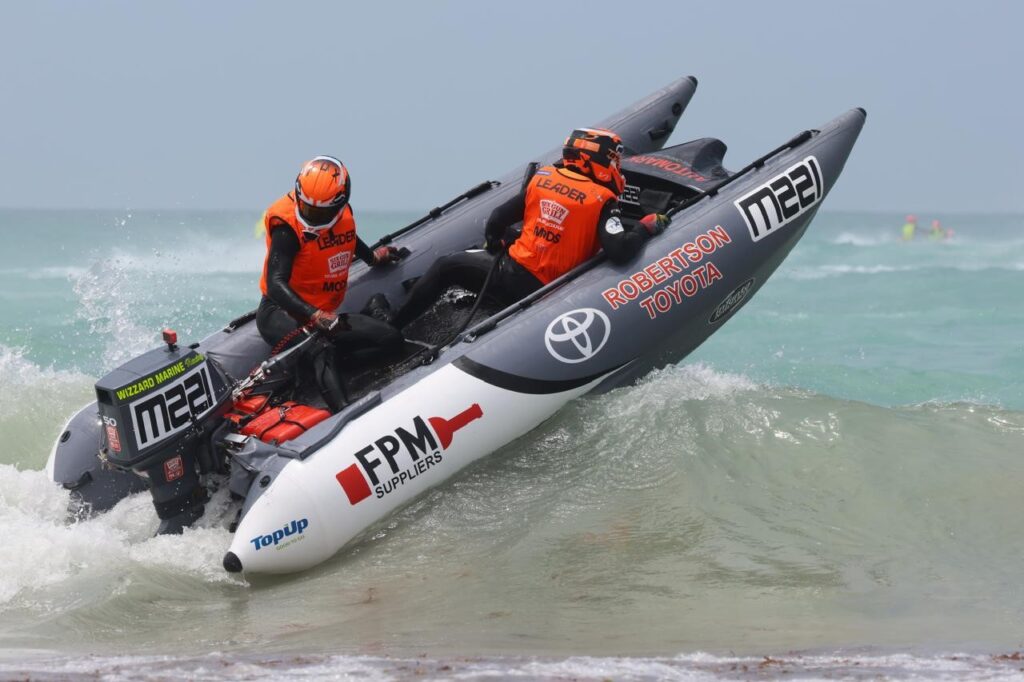
Thousands of holidaymakers and beachgoers lined the coastline over the festive period as the legendary Six Gun Grill Trans Agulhas Inflatable Powerboat Challenge once again lived up to its reputation as the toughest boat race in the world. From 28 to 31 December, the iconic endurance race stretched from Plettenberg Bay to the Strand in Cape Town, serving up speed, spectacle and sheer survival along South Africa’s unforgiving coastline.
At the sharp end of the field, it was business as usual for Eben de Bod, who powered his way to a remarkable sixth consecutive overall victory. Adding to the significance of the achievement was a late co-pilot change, with Devan Marais teaming up with De Bod for the first time. Despite the lack of race-time chemistry, the duo delivered a flawless performance under pressure. Second overall went to Wehan Malan and Harry Erasmus, while Ayrton Martinengo and Dylan Burger completed the podium in third place after four demanding days at sea.
Picture credit: Heinrich & Rona Sauer Photography
The Trans Agulhas is contested across three fiercely competitive classes – Stock, Pro-Stock and Modified – and covers approximately 700 kilometres over four days. Day one saw the 48 competing teams take on a brutal 188-kilometre opening leg from Hobie Beach in Plettenberg Bay to Santos Beach in Mossel Bay. Ideal sea conditions allowed the boats to reach speeds of up to 95km/h, with several teams posting record times. The deceptively smooth conditions lulled many of the 14 rookie crews into a false sense of security, leaving them questioning why the Trans Agulhas is spoken about in such fearsome terms.
That question was emphatically answered on days two and three, as the race revealed its true character. Choppy seas and relentless pounding forced four co-pilots to withdraw with injured ribs, highlighting just how physically punishing the event can be. Thick fog on day two prevented a sea start from Mossel Bay, forcing teams to travel by road to Stilbaai. There, organisers had set up a demanding 28-kilometre circuit that had to be completed six times, with compulsory beach stops after each lap adding to the challenge.
Fog again played a decisive role on the final leg from Struisbaai to the Strand. Teams were transported by road to Gansbaai, where they launched behind the safety boat and travelled in formation until visibility improved. Once the fog lifted and the flag finally dropped, the fleet charged toward the finish line for one last, adrenaline-fuelled push to the Strand.
Picture credit: Heinrich & Rona Sauer Photography
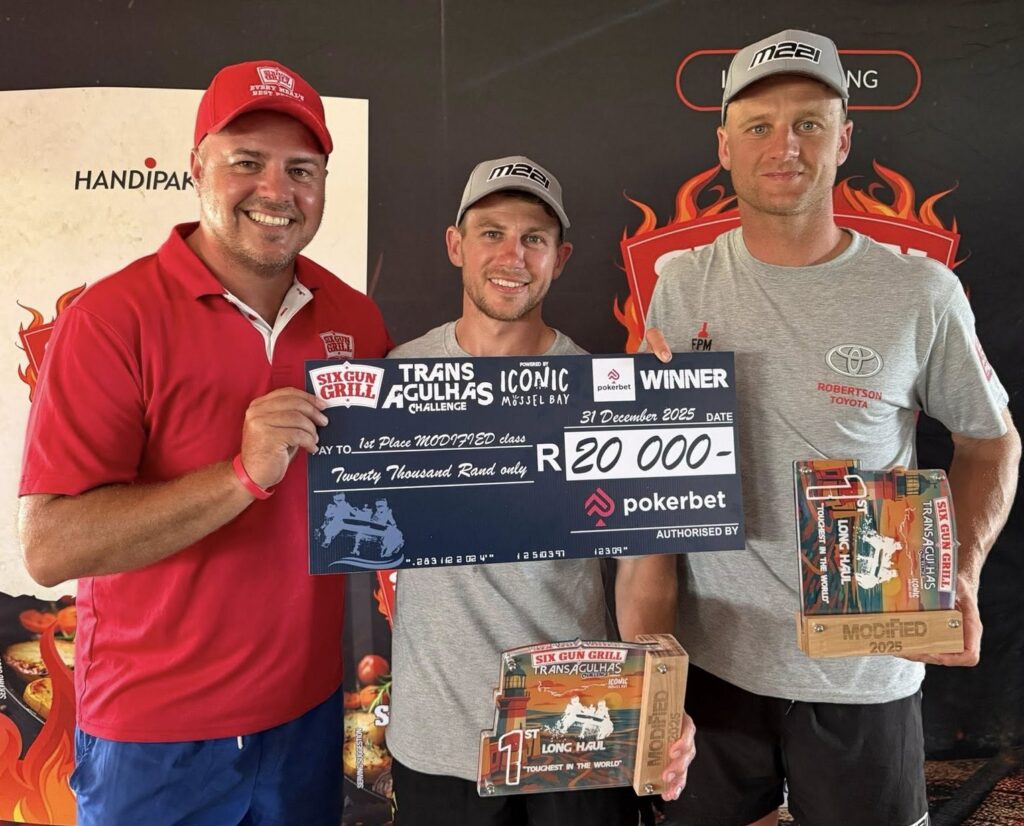
In the class results, De Bod and Marais claimed victory in the Modified class, while Malan and Erasmus won the very competitive Pro-Stock category. The Stock class honours went to Dean Kruger and AJ Bosch while a standout performance came from rookie pairing Jan-Harm Swanepoel and Dylan Lloyd, who not only finished as the first new-comers home but also secured an impressive second place overall in the Standard class.
The action didn’t end with the long-haul stages. To the delight of spectators, competitors returned to the water just half an hour after the last boat had finished to contest the Six Gun Grill King of the Waves. The short, high-intensity surf circuit consisted of five laps and delivered close racing in front of packed beaches. De Bod and Marais again proved unstoppable in the Modified class, while Rikus Roux and Ian Hall took the Pro-Stock honours and Dihan Spies and Steyn de Wet emerged victorious in the Standard class.
The event also showcased the depth of South Africa’s inflatable boat industry, with six different manufacturers represented. Infanta Inflatables of Swellendam ultimately walked away with the coveted manufacturers’ award, underlining their consistency and reliability in the harshest of conditions.
Once again, the Trans Agulhas Challenge delivered drama, endurance and unforgettable racing, cementing its status as one of the ultimate tests of man, woman, machine and teamwork on and off the water.